Caithness sits at the junction of the North Sea and the Atlantic, and the Scots and the Norse disputed its ownership for centuries. The Sinclairs controlled much of Caithness in medieval times, and they first built here in the 1300s. They enlarged and improved the Castle over the next three centuries. But it fell into ruin from 1680 onwards by which time it had fallen out of out of Sinclair control.
The first days of the Castle – the 1300s
There are no written records of the earliest buildings here. The Castle runs east to west on its rocky peninsular, and antiquarians thought there was earlier ‘Castle Girnigoe’ at one end and a later ‘Castle Sinclair’ at the other. But archaeologists found just one set of buildings from the 1300s onwards, running the length of peninsular.
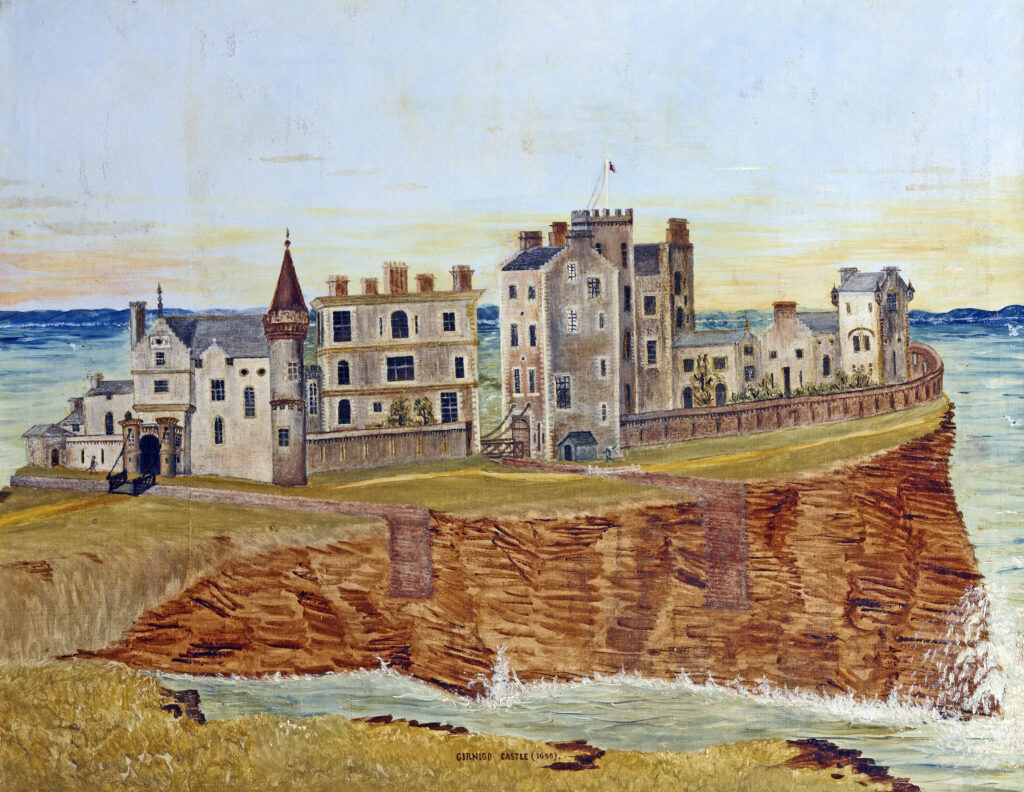
Painting showing two castles, ‘Sinclair’ and ‘Girnigoe‘, as they were thought to be in 1648 – probably a Victorian artists’ impression.
Image courtesy of Highland Council / www.ambaile.org.uk
The Sinclairs in Caithness
Likewise, the origins of the Sinclairs are lost to time. Their ancestry may go back to Rognvald ‘the Mighty’, a Norwegian Jarl in the 800s, who was also an ancestor William the Conqueror. In 1070, King Malcolm III is thought to have granted the barony of Roslyn near Edinburgh to William St Clair, called William ‘the Seemly’.
In the mid 1300s, Henry St Clair of Roslyn married the heiress of the Earl Orkney and Earl of Caithness. This brought the family here, but it also meant they owed allegiance to both the Scottish and Norwegian crowns.
The Sinclairs built castles in Thurso, Mey, Keiss, Brall, and Dunbeath. But the Sutherlands, the Keiths and the Mowats also had castles here. This shows us how violent the long-standing feuds in the area were, in particular the rivalry between the Sinclairs on one side and the Gunns and the Mackays on another.
A stronghold rising from the sea – the 1400s to 1600s
In the late 1400s, William, 2nd Earl of Caithness, built much of the Castle, which became his home.
His grandson, Earl George, the 4th Earl, supported Mary Queen of Scots, and rebuilt much of the Castle in the refined styles of the Scottish Renaissance. He had a fearsome reputation, and there is a tale that he imprisoned his son John in the Castle, feeding him salt beef so that he eventually died tortured by thirst. John is said to have murdered his brother William for taunting him in his confinement by strangling his brother with the chains that held him fast to the Castle walls. There is little evidence that these tales are true.
The 5th Earl, ‘Wicked’ Earl George, completed his father’s work on the Castle. He needed the Castle to be a stronghold because he loved nothing more than antagonising neighbouring families. He provoked the Earl of Sutherland into laying siege to the Castle for twelve days. The Castle withstood the siege, but Sutherland burned the nearby land and houses.
The Castle was the largest building in Caithness. In 1606, the name was changed by Act of Parliament from Castle Girnigoe to Castle Sinclair, giving rise to the idea that there were two castles here.
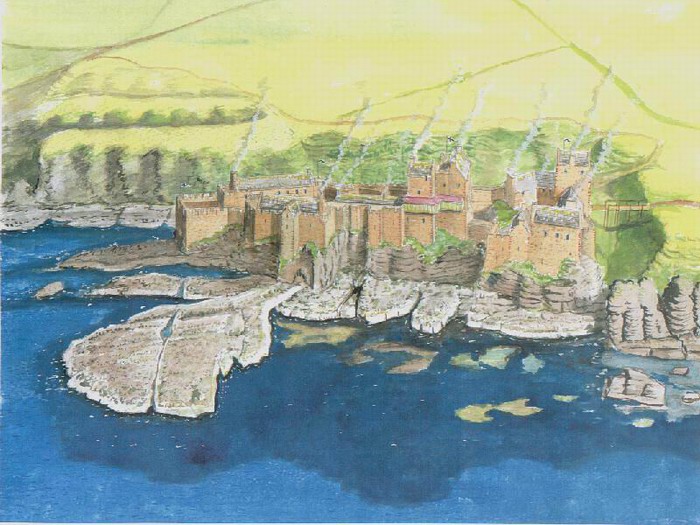
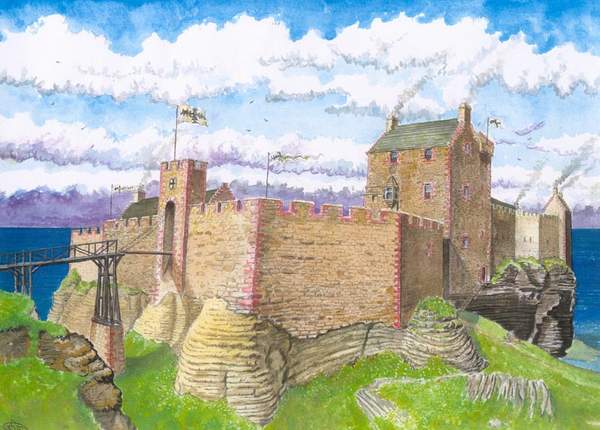
Castle Sinclair Girnigoe as it may have looked in the early 1600s and in 1690, illustrations by Andrew Spratt. (PERMISSION NOT YET GRANTED)
The ruin of a fortress – the 1600s
However, pride comes before a fall, and ‘wicked’ Earl George overspent himself and was declared bankrupt in 1616. In 1623 the Castle was captured by Robert Gordon and the Earl of Sutherland’s men. Worse was to follow. In the 1650s the Castle was used as a base by Parliamentarian troops during the War of the Three Kingdoms (known as ‘the Civil War’, in England), with seventy foot soldiers and fifteen horses garrisoned here. Caithness was strongly Royalist, and the Parliamentary troops burned land and houses all around.
The debt and decline continued, and in 1677 the Castle was passed to Thomas Calderwood, a merchant burgess of Edinburgh. The Earl sold his title and the rest of his estates to his his principal creditor, his cousin John Campbell of Glenorchy.
This did not go down well with other Sinclairs; George Sinclair of Keiss claimed to be the rightful heir, and laid siege to the Castle, damaging it beyond repair. In 1719 Glenorchy was forced to sell his lands, and Castle Sinclair Girnigoe passed to the Dunbar family of nearby Ackergill.
The imposing fortress had been reduced to dramatic ruins.


The Castle in 1760, by Richard Pococke, Bishop of Meath – images from Archive.org and Wikimedia Commons
Recognition
Antiquarians in the 1700s and 1800s were fascinated by the picturesque ruins and violent and romantic stories about the Castle, and we can trace the Castle’s continued decline through the pictures they drew of it.


Illustrations published in 1884 by McGibbon and Ross – Internet Archive
The Castle was classified as a Scheduled Ancient Monument in 1935, and rescheduled by Historic Scotland in 1996. The Castle was included on a list of the 100 Most Endangered Sites in the World by the World Monuments Fund in 2002.
For a comprehensive history of the Sinclairs and the Castle, see Part 1 of the Castle Sinclair Girnigoe Conservation Plan Vol 1.