Castle Sinclair Girnigoe is perched on a clifftop abutting the North Sea, some five miles north of Wick. It is one of the best known stops on the North Coast 500 visitor route passing through Caithness, and it’s easy to see why. Atmospheric, ruined, with a history of clan disputes and family feuds, the Castle is everything we imagine a ruined Scottish castle to be.
Visiting Castle Sinclair Girnigoe
- Cost: The Castle is free to visit, though there is a charge for parking
- Location: 5 miles north of Wick, Caithness
- Parking: Noss Head car park, What3Words: ///apart.safest.boldest
- Accessibility: A 500m walk on gently sloping ground which may be muddy at times
- Access: The grounds and exterior are open to explore, but the interior is currently closed for safety
- Drones: Permission required from Wick Airport before flying
Please respect the fragile fabric of the building. The Castle is an ancient monument and so it is illegal to climb on the structure. Keep your dog on a lead because there are cliffs and livestock nearby.
The Past
The origins of both the Castle and the Sinclairs are lost to the mists of history. The Sinclairs may have Norse origins. Their close connection with the far North began in the mid 1300s when Henry Sinclair of Roslyn married into the family of the Earls of Orkney. His grandson William was the first Earl of Caithness. The earliest archaeological finds at the Castle date to this time, though it was his son William who built much of the Castle in the 1400s.
The Sinclairs were a fearsome family. There are rumours of fathers killing sons, and brothers killing brothers. They fought their neighbours, and ruled over most of Caithness from the 1400s to the 1600s, and extended the Castle throughout this time.
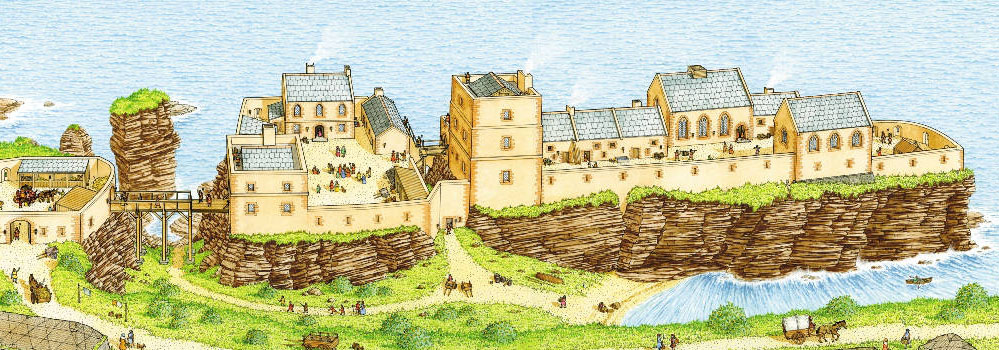
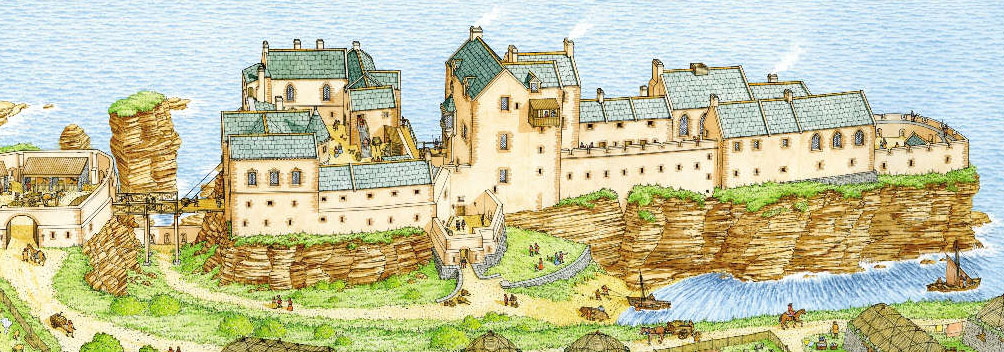
Reconstructions of the Castle at different periods by Pelican Design Consultants
The 1600s saw the Castle at its peak. It was the largest building in Caithness. But the 1600s also saw its ruinous fall. During this time the Sinclairs faced bankruptcy, and the Castle was occupied first by the Earl of Sutherland’s men and then by Parliamentarian Troops during the War of the Three Kingdoms (known in England as ‘The Civil War’). In 1677 the Earl’s indebtedness led him to hand over the Castle and his Earldom to John Campbell of Glenorchy.
Ironically, it was a Sinclair who turned it from a fortress to a ruin. George Sinclair of Keiss claimed to be the rightful heir, but his attacks damaged it beyond repair. The the ruined castle was eventually passed to the Dunmbars in nearby Ackergill.
The Castle was classified as a Scheduled Ancient Monument in 1935, and rescheduled by Historic Scotland in 1996. The Castle was included on a list of the 100 Most Endangered Sites in the World by the World Monuments Fund in 2002.
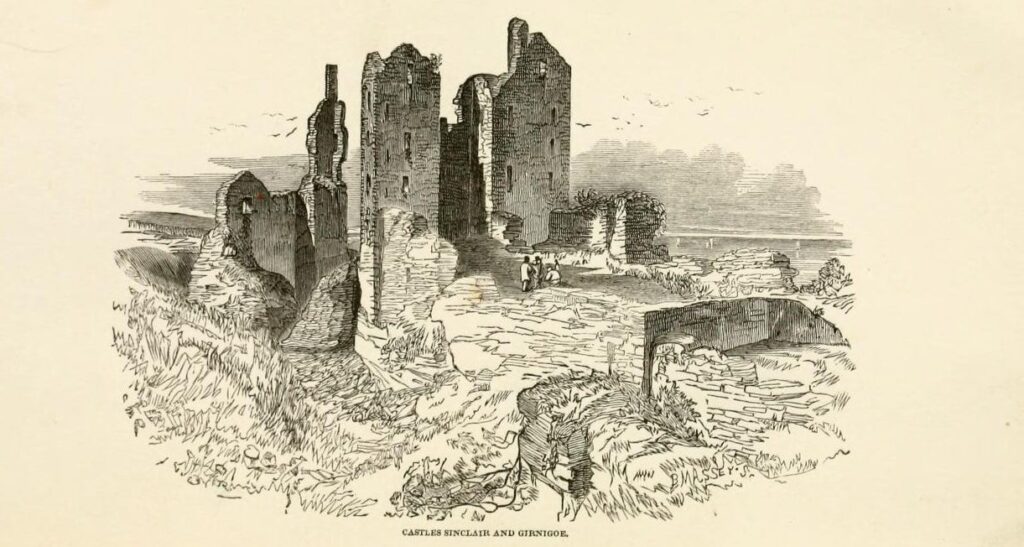
Calder’s 1861 illustration of the Castle from the East – Wikimedia Commons.
The Present
The Castle returned to Sinclair ownership in 1953 when the Dunbars sold the Castle to the Earl of Caithness. In 2000 it was passed to the Clan Sinclair Trust, whose main trustees were the Earl of Caithness and Lord Thurso.
Archaeological discoveries
The Clan Sinclair Trust faced two main questions
- How to find out more about the past of the Castle?
- How best to stabilise the fabric of the Castle for the future?
They commissioned Archaeological and structural surveys and a comprehensive Conservation Plan to answer both questions.
The archaeological finds confirmed continual use from the late 1300s to the late 1600s, and the Trust commissioned some structural stabilisation that took place between 2005 and 2011 to secure the surviving ruins. However, the Castle is subject to fierce winter storms, so more structural work is needed to stabilise the fabric, and the interior of the Castle is currently closed for safety reasons.


Castle Sinclair Girnigoe today – photo by Ben Makin
Castle Sinclair Girnigoe in 1780 – image from ‘Antiquities and Scenery of the North of Scotland’ by Rev Charles Cordiner, courtesy of www.ambaile.org.uk
The North Coast 500 route and visitors today
The North Coast 500, or NC500, is a visitor route around the north coast of Scotland, and the Castle is one of the most spectacular and most visited spots on the journey. Many visitors leave five star reviews, and post spectacular pictures online.
The Future
In 2026, the Clan Sinclair Trust passed the baton of custodianship to the Castle Sinclair Girnigoe Trust, a charity registered in Scotland (SC055556).
The Trust aims to continue the work of the Clan Sinclair Trust, and further secure the fabric of the buildings and the future of the Castle by working with heritage groups, members of the Clan across the world, and with the local community here in Caithness.
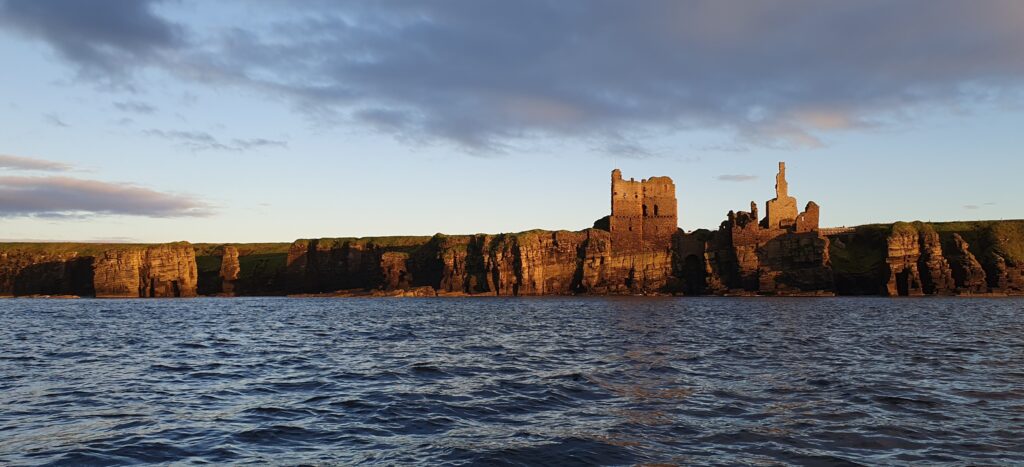
Castle Sinclair Girnigoe from the sea: photo by Ben Makin
Be part of the Castle’s Story
The Castle Sinclair Girnigoe Trust (Scottish Charity SC055556) continues the work of securing this castle’s future — for visitors, for the local community, and for members of the Clan Sinclair around the world.
However you’re connected to the Castle, there’s a way to be part of its next chapter.
Members can speak and vote at our General Meetings, and stand as Trustees. £10/year for adults, £5/year for Junior Members (ages 12–15). Must be 16+ to vote or become a Trustee.
For Clan Sinclair members and supporters around the world. Associates can speak at our General Meetings and stay closely connected to the Castle’s story and its future.
The Castle has survived siege, bankruptcy, and centuries of storms. Your donation helps us stabilise the fabric, maintain paths and fences, and keep Girnigoe safe to visit.
News, restoration updates, and stories from the Castle’s next phase — straight to your inbox. Read our Privacy Policy. You can unsubscribe at any time.


Find out more about Membership and the Trust.